Home / Blog

Blog

The Science of Writing Down Your Goals

The Science of Writing Down Your Goals

The science of journaling and goal setting

Have you ever heard the saying "what gets written gets done?" It's a popular phrase that highlights the importance of writing down our goals to increase the likelihood of achieving them. But why is this the case? What is it about the act of writing down our goals that makes them more likely to be achieved?

Writing down your goals daily makes you 42 percent more likely to achieve them.

According to scientific research, there are several reasons why writing down our goals can be so powerful.

Here are just a few of the key ways that writing down our goals can help us to achieve them:

  1. Writing down our goals helps us to clarify our thoughts and priorities: When we take the time to write down our goals, it forces us to clarify our thoughts and priorities. This process of clarifying our goals helps us to better understand what we want to achieve and why it is important to us.
  2. Writing down our goals helps us to break them down into smaller, more manageable steps: When we write down our goals, we can also break them down into smaller, more manageable steps. This process of breaking down our goals into smaller steps makes them seem more achievable and helps us to see a clear path forward.
  3. Writing down our goals helps us to stay accountable: When we write down our goals, we are more likely to stay accountable to ourselves and track our progress towards achieving them. This sense of accountability can help to keep us motivated and on track.
  4. Writing down our goals can help to activate our brains: Research has shown that writing down our goals can actually activate certain areas of our brains that are associated with planning and goal setting. This activation of these areas of the brain can help us to better focus on our goals and take the necessary steps to achieve them.

Overall, the science is clear: writing down our goals is an important step in the process of achieving them. By taking the time to clarify our thoughts, break down our goals into smaller steps, stay accountable, and activate certain areas of our brains, we can increase our chances of success and achieve the things that are most important to us.

What are leading indicators of success in your life?

Leading Indicators Affects

Leading indicators

As Eminem so politely tells us, you have one shot, one opportunity. And I hate to break it to you, but you’ve just blown yours. Moms spaghetti.

You might think that it was just an off day, you just weren’t quite good enough for that final stage interview, or to resist that drink, to win that new big customer contract, to get picked for the team, to be made best man/bridesmaid. You name it. Those big wins in life we hope to achieve and those failures we try to avoid, it’s inevitable we will experience some of them. But why do some people succeed more than they fail?

Could it be because they operate their lives in accordance with the leading indicators of success? 

What are leading indicators?

Leading indicators of success are measurable factors that provide insights into the future performance or achievement of a particular goal or objective. Leading indicators help organisations and individuals anticipate and take proactive steps to improve outcomes. VERY businessy talk I know. But stick with me.

What are some examples of leading indicators in your life?

  1. How much exercise you do, how healthy your diet is and how well you are able to sleep are all leading indicators of health, long-term well being
  2. How well you are able to save and earn money each month will be a leading indicator of your savings, investments and freedom for the future

  3. How much time and energy you put into your relationships will be a leading indicator of the quality and depth of your relationships in years to come


What are the lagging indicators? 

Lagging indicators happen after the fact, they are simply a reflection of the leading indicators. Did you make the team, get the promotion, or finish the degree? They are the milestones, successes or perhaps failures. It's important to keep in mind that while lagging indicators are informative, they provide insight into the past rather than helping you actively shape your future.

They are helpful in evaluating the outcomes of your behaviours over time to assess to progress. If they are the only measurement though we may often miss the target and not be able to diagnose why. 

Lagging indicators vs leading indicators

How can you avoid measuring lagging indicators of success?

Lagging indicators vs leading indicators is a balance that is important to strike. Understanding that your success or failure often is determined by leading indicators can be a big step in your own self-development. 

For example, as mentioned above an alcoholic failing to resist a drink, a good one as any vice or addiction can be inserted instead. 

Did they drink and break their sobriety because of a momentary lapse of willpower or did some external event trigger causing them to turn to their old friend to escape the pain?

Possibly, or perhaps it was down to a series of leading indicators of risk. 

In the weeks before everything on the surface was not bad leading up to the moment of relapse. 

Not thinking it was much of a big deal in isolation thanks to a busy schedule and a sense of feeling on top of things the last couple of therapy sessions or group meetings had been missed. 

Because they were busy and felt like they still needed the time to themselves in the evening to unwind their sleep had reduced down to around 6.5 hours per night.

The same busy schedule, late nights and shitty weather had piled on the excuses to cut down on the exercise and because their pen was out of ink the journaling had fallen by the wayside. 

These all may seem like relatively insignificant small parts of the day, if you were their close friend or loved one you might not have even noticed any of those habits had changed in the last few weeks. 

However when it comes to leading indicators and in life generally the little things are the big things. 

Your success in getting out of bed in the morning isn’t made by your willpower in the morning but by your ability to consistently go to bed at a sensible time that allows for enough sleep. 

Your single drink when you are struggling with alcoholism is in fact its own leading indicator, you’re not in crisis with serious health concerns (lagging indicator) during or right after a singular drink. However, after going down a well-trodden and somewhat predictable path, you may well be. 

To avoid the leading indicators of failure turn to the leading indicators of success. 

How can the leading indicators help me?

Knowing this you can be clear on the power your consistency will have; the power of consistent routines will give you a competitive advantage in your own life. 

Just look for the outcome you want to achieve and then reverse engineer it. You want deeper and more meaningful friendships. Ask yourself what are the consistent actions you can take to help nurture them. 

If you want to take better care of yourself, ask what routines and daily habits would move you in the right direction.

“If your choices are beautiful, so too will you be.” –Epictetus.

The amazing thing about the leading indicators is that they are predictors of the future. You can use them to course correct so you land where you desire.

We highly recommend writing down the answers to the following questions and keeping track of your progress in your journals, notebooks, phone’s notes section, or whatever floats your boat.

Journal prompts

  1. What successful outcomes do I want in each major area of my life? (Health, wealth, relationships and freedom)
  2. What are the leading indicators of success for these outcomes?
  3. What are the leading indicators of failure for these outcomes?
  4. How can I create habits and routines for success?
  5. How can I track these habits? If you want a structure, we have you covered with The Evolve Journal.

You can use them to create non-negotiables that then become the winning lottery ticket, all you need to do is follow the process and you’re probability of winning is astounding. 

Understanding the Hedonic Treadmill for Happiness

Hedonic treadmill Metaphor

Ever wondered what it would be like to win the lottery? Spent hours pondering what you would buy first, how much you would give away and who was on the list to receive it?

Undoubtedly we all assume to a certain degree that winning the lottery would solve all our issues one way or another. If we just had an obscene amount of cash, we’d be just fine until the rest of our days. 

Well, perhaps not. 

Research actually shows in many cases, there is little to no improvement in a person's happiness post lottery win. 

“We find that winning large sums of money strongly affects how content you are with your personal finances. But it does not affect how you feel about other aspects of life, such as your health, or your relationships with friends and family,” said Erik Lindqvist

So how could this be?

Introducing the Hedonic Treadmill

Did you know you’ve been running all your life and an imaginary treadmill? No wonder you’re often tired and hungry ay!

What is the hedonic treadmill?

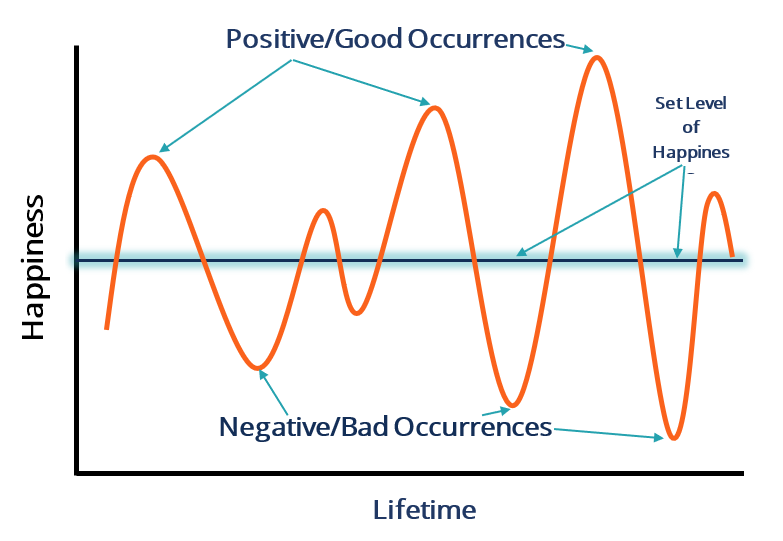
The hedonic treadmill or hedonic adaptation theory refers to the psychological phenomenon where people tend to quickly return to a relatively stable level of happiness or satisfaction after experiencing positive or negative events, such as acquiring new possessions, achieving goals, or facing setbacks. In other words, despite changes in external circumstances, individuals revert back to their baseline level of well-being over time.

“Until we have begun to go without them, we fail to realise how unnecessary many things are. We’ve been using them not because we needed them but because we had them.” - Seneca

Why should you care about the hedonic treadmill?

The treadmill metaphorically represents a long-term struggle without much progress, just like those heroes working in lifts you have your ups and your downs and after all, you are stuck in the same happiness position overall. 

You should care because the hedonic treadmill teaches us an important lesson. That we shouldn’t be chasing the temporary dopamine hit we get from achieving a goal, buying a new fancy thing or watching the numbers on our bank balance go up. We should instead think about how we can increase our baseline level of happiness so when we have the inevitable spikes in life, we return to a baseline level of happiness that is much higher than if we hadn’t worked on ourselves. 

This is aequanimitas latin for equanimity. Aequanimitas was the last word uttered by Antoninus Pius (cracking name) and probably one of my favourite words, it is simple in nature but difficult to master, so much so we are still talking about the pursuit of it centuries after Pius on his death bed. 

What does equanimity mean?

The ability to maintain a calm and steady state of mind, characterised by a balanced and stable mindset. 

By pursuing equanimity, instead of big happiness spikes, we can smooth out the curve meaning we stick closer to a stable baseline. One that is rational and proactive, that realises we have the option to choose how we think and feel about things. 

It protects us from pouring our energy into the wrong places and actually being worse off when we realise that all of our efforts didn’t bring us the happiness we wanted. 

If we set goals while hating the journey, we set ourselves up for failure. We must understand that the journey of evolution is to be enjoyed and the end goal is just a happy coincidence in doing what we loved. We can cultivate an understanding that the obstacles in life should not be avoided or feared, but rather embraced and used as opportunities for growth, learning, and self-improvement.

If we chase shiny things we will end up doing things we don’t like to own possessions that own us, we will end up in very expensive golden handcuffs trapped and addicted to material things that won’t make us nearly as happy as one single meaningful relationship could. 

As King Midas found out, infinite wealth of the wrong kind can easily become a curse.
If Only Happiness Were A Big House And A Fancy Car : The Prudent Investor

Credit: theprudentinvestor.in

If know we are prone to short temporary bouts of increased happiness before we return back to our baseline level of happiness, this knowledge should change our relationship with happiness and how we chase it. The aim should be not for short temporary increases but to improve your baseline level of happiness over time.

In Germany pioneering happiness researchers Fujita and Diener examined changes in baseline happiness and wellbeing over a 17-year large sample study of Germans! 

What they found was very interesting. While there was significant stability in the happiness assessments (those stuck on the hedonic treadmill in the status quo) 24% of participants experienced a significant change to their happiness level showing that long-lasting improvements can be made outside the hedonic treadmill. 

They found that there are a number of internal circumstances under your own voluntary control which while they all require real effort, these changes have the power to increase your happiness lastingly.

So now we have our sights on something powerful and long-lasting. Something that less than a quarter of people manage to achieve. We can take a break from the treadmill way of life.

We can start building a life that focuses on long-term happiness. Building strong fundamental pillars of happiness relationships, health, wealth and freedom.

“Wealth consists not in having great possessions, but in having few wants.”- Epictetus